

Get Free Hyperrealism Brows Pattern Training: HERE
You’ve taken the trainings. You’ve practiced your strokes. You’ve followed the patterns step by step.
And still… your machine hairstroke brows don’t quite look real.
They’re clean. They’re polished. But they don’t have that effortless, undetectable finish clients are starting to expect.
Here’s the part most artists don’t hear enough:
It’s not your effort. It’s not even your machine work.
It’s your pattern foundation.
After helping thousands of PMU artists refine their hairstroke technique, one issue keeps showing up. There’s a key step that gets skipped in most trainings, and without it, your work will always feel just slightly “off.”
In this post, we’re breaking that down so you can start creating brows that don’t just look good… they look real enough to charge more for.
Watch the Full Breakdown
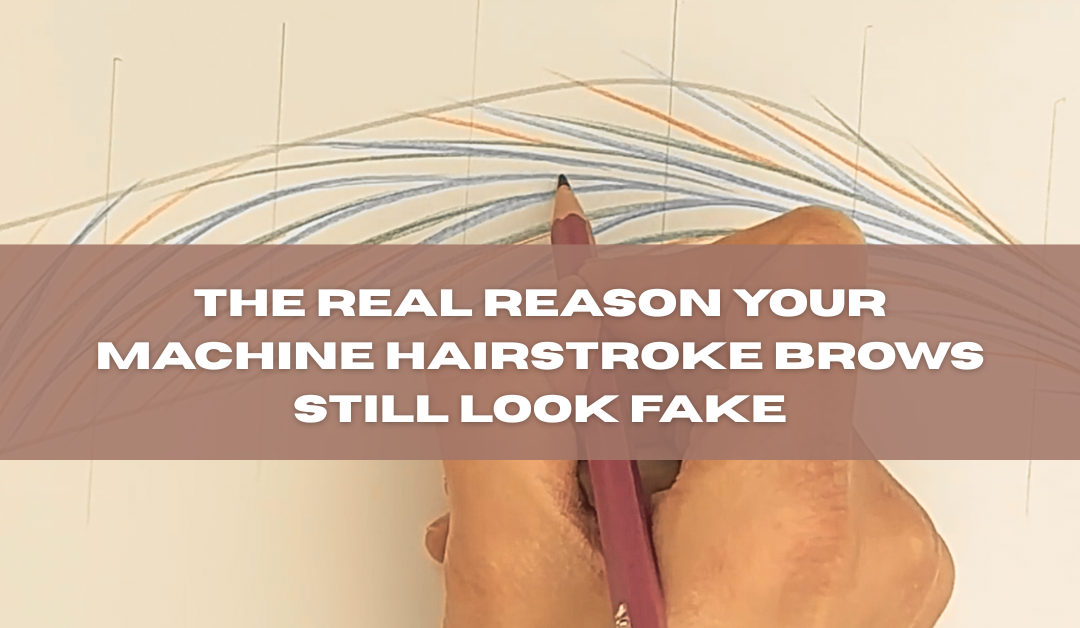
Before we dive deeper, here’s the full walkthrough where you can see exactly how this pattern is built step by step.
Why Your Pattern Is Everything
Hyperrealism doesn’t start when your needle touches the skin.
It starts with how you design movement.
A realistic brow isn’t just a collection of strokes placed neatly next to each other. It’s flow. Direction. Spacing. Imperfection in the right places.
And all of that begins with one thing:
The spine.
Step 1: Get Your Medium Spine Right
The medium spine is your baseline. It suits clients whose natural brow hair grows straight through the middle, not lifting too high or dropping too low.
But placement is where most artists slip.
If your spine sits too high, your strokes will look unnatural.
If it’s too low, the brow loses balance.
What you want is a spine that sits evenly between the top and bottom of the brow, acting as a guide for everything that follows.
Not a rigid line. A pathway.
Step 2: Build Primary Strokes That Flow
This is where your pattern starts to come alive.
Your primary strokes should never feel stiff or forced. Straight lines are the fastest way to make brows look artificial.
Instead, think in soft S-curves:
- Start from the spine
- Let the stroke transition naturally
- Keep it slightly thicker through the middle
- Taper it gently at the end
As you move toward the front of the brow, your strokes should become softer and more rounded. Less structured. More organic.
That subtle shift is what creates a believable front.
Step 3: Stop Connecting Everything
This is the missing piece for most artists.
You don’t need every stroke to connect.
In fact, forcing connection is what creates that heavy, crowded look.
Real brows have space. Separation. Air.
So instead:
- Keep some connections loose
- Add standalone strokes where needed
- Leave intentional gaps
This creates what feels like a double spine effect. A base structure with a secondary flow running slightly above it.
That separation is what gives your work that light, natural finish once healed.
The Layering System That Makes It Easy
Once your primary strokes are in place, everything else becomes simpler.
You’re no longer guessing. You’re refining.
- Primary strokes set the direction
- Secondary strokes help close obvious gaps
- Tertiary strokes soften and balance the pattern
From there, you assess before adding anything else.
Because more strokes don’t mean better results.
Better placement does.
Direction Matters More Than You Think
One detail that instantly gives away unnatural brows is incorrect direction.
Real brow hair grows from the top down.
So your strokes should follow that same movement.
If they don’t, the result will always feel slightly off, even if everything else looks technically correct.
When to Add Detail… and When to Stop
Detail strokes are there to refine, not to fix poor structure.
Use them only when:
- There are larger gaps disrupting the flow
- The client has minimal natural hair
- You need to soften transitions, especially at the front
Otherwise, leave it alone.
Some of the most realistic brows come from knowing when to stop adding.
One Pattern Will Never Fit Every Client
The medium spine is just one pattern.
And while it’s a powerful foundation, real artistry comes from knowing how to adjust your design based on your client’s natural hair growth.
Because the goal isn’t to create a perfect pattern.
It’s to create a pattern that looks like it was never tattooed in the first place.
Want to charge premium prices and attract high-end PMU clients, without doing it all alone?
If so, join the Hyperrealism Brows Foundation community, it's free to join and you'll be alongside over a thousand other artists who are all working towards the same thing.
Artists who share their practice work, ask the questions you didn't know you were allowed to ask and remind you on the hard days that you're not doing this alone.
Free training covering mapping, patterns and business advice are waiting for you from day one.

See you inside,
Kim x

 Chat via WhatsApp